 Dinner Pals
SOMETHING YOU CAN POINT TO
Time passing. In full colour.
A visual timer turns a duration into a changing image. In Dinner Pals, a character fills with colour as time passes.
That gives you a shared reference: you can point to the progress instead of asking your child to keep an invisible countdown in mind.
The timer shows time. Explain what happens afterwards, too.
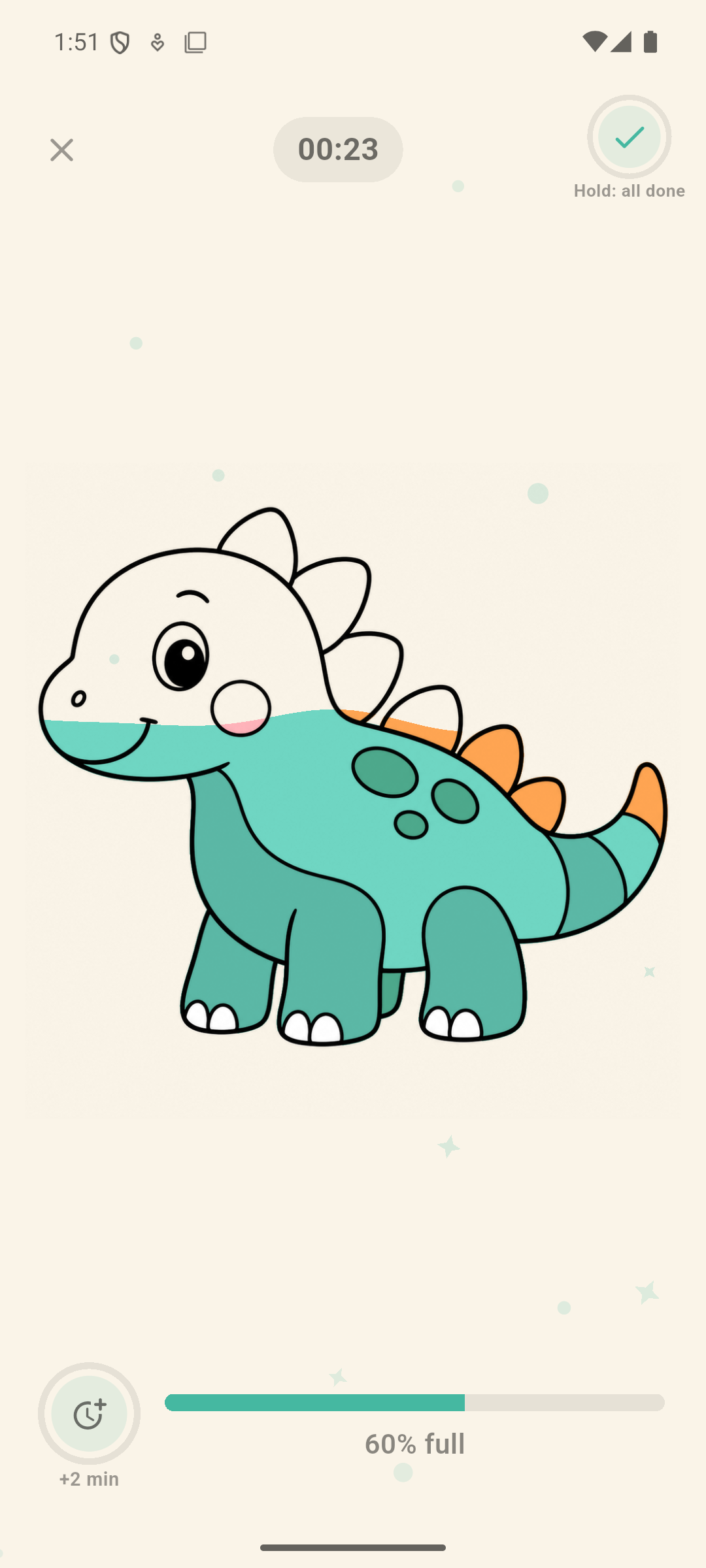

The timer shows time. A separate picture or explanation shows what follows.
THREE DIFFERENT QUESTIONS
When? What next? What support?
How long?
A timer shows a period of time passing.
What follows?
A schedule or picture card shows the next activity.
What support?
An adult helps explain, adapt and respond.
These tools do different jobs. Research about visual schedules is relevant background, but it does not automatically establish the effectiveness of a countdown app.
FOLLOW THE RESEARCH
What does the evidence support?
Time skills, with several supports
An ADHD study found improvements from a programme combining time-skills training, professional support and assistive devices, including timers. It did not isolate the effect of a timer. Wennberg et al., 2018.
A small classroom experiment
A school experiment with 44 children aged 7–9 compared timed maths tasks with and without a visible timer. Anxiety before the task and some observed inattentive behaviours were lower with the timer, but maths scores did not significantly improve. This was not a Dinner Pals or autism-specific trial. Hallez & Vallier, 2025.


TRY ONE ORDINARY MOMENT
The toothbrush is down. The two minutes aren’t.
Before brushing, show Brushy and explain what the colour means. Set two minutes and stay alongside your child. Notice whether they use the picture to understand the time.
This is an illustrative routine to try, not a tested Dinner Pals protocol or a substitute for helping with brushing.
- Choose a familiar activity and a duration that makes sense for it.
- Explain the cue before starting. Say what will happen afterwards.
- Try the sound off if that suits your child.
- Notice clarity, comfort and engagement—not just whether they beat a deadline.
- If the display adds pressure or distraction, pause and try another cue.

LEAVE ROOM FOR FLEXIBILITY
A cue, with you beside them.
A timer does not measure effort, hunger or readiness. During meals, it should not decide whether a child has eaten enough.
During a difficult transition, responding to your child matters more than completing a countdown.
Explore the ADHD guide, the autism and transitions guide, or the research library.